Your flight lands, the seatbelt sign turns off, and you need data before you reach baggage claim. Maps, rideshare, hotel messages, work chats, and boarding updates do not wait for a carrier store to open. The global eSIM or local carrier decision is really about one question: do you want connectivity ready before you arrive, or are you willing to spend time setting it up after landing?
For many US travelers, a travel eSIM is the faster choice. But local carriers can still make sense for certain long stays, heavy data use, or destinations where one domestic network is clearly stronger. Here is how to choose based on the trip you are actually taking.
Global eSIM or Local Carrier: Start With Your Trip
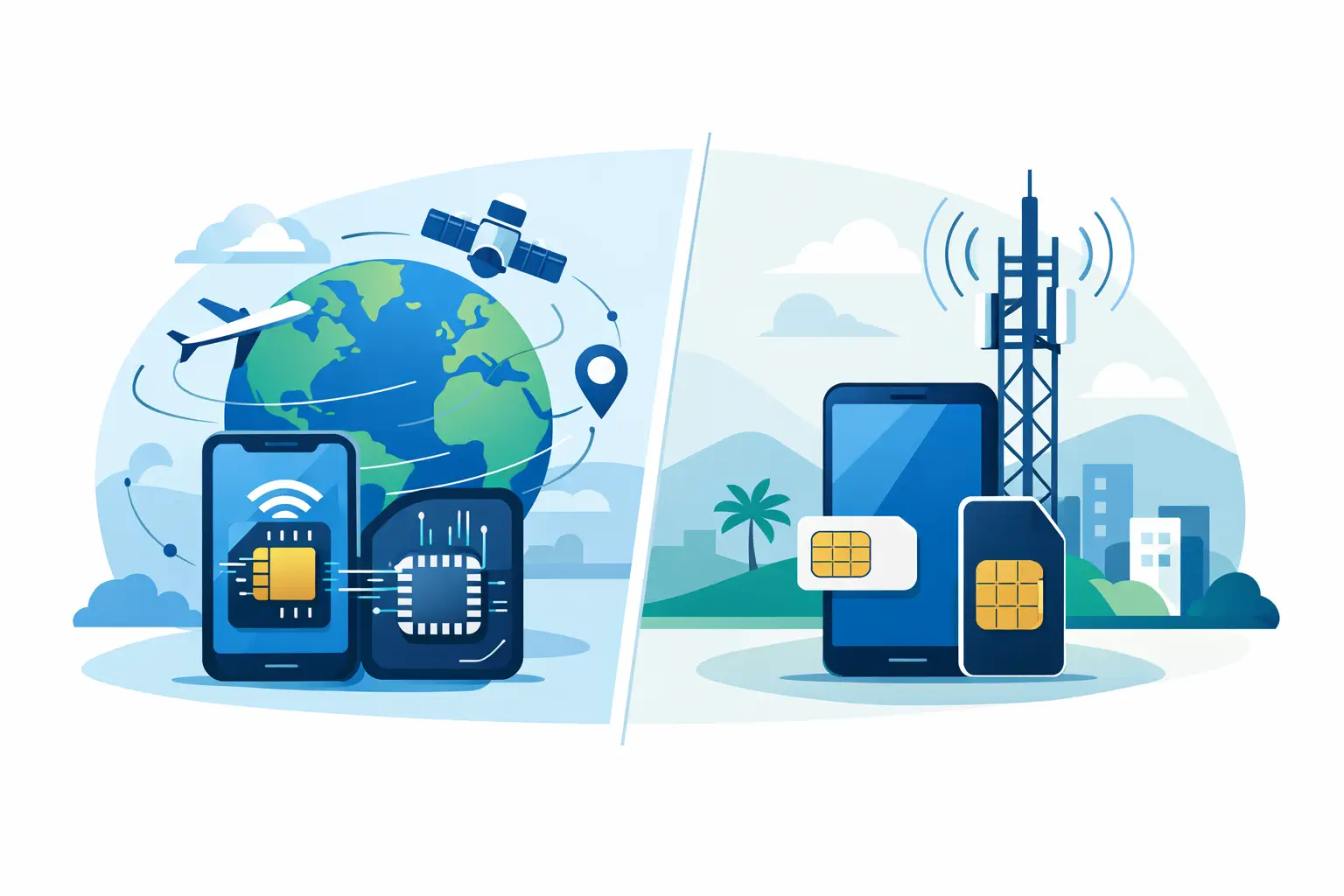
A global eSIM is a digital data plan that can work across multiple countries. You buy it online, receive activation details, scan a QR code, and install it on an eSIM-compatible phone. Depending on the plan, you can connect in one country, cross a border, and continue using data without buying another SIM.
A local carrier plan is purchased from a mobile operator in your destination. That may mean visiting an airport kiosk, a retail store, or an authorized reseller. You may receive a physical SIM, an eSIM, or both. Local plans are tied to one country and often use that carrier's own network directly.
The best option depends on how long you are traveling, how many borders you will cross, how much data you need, and how much setup friction you are willing to accept. There is no single winner for every traveler.
Why a Global eSIM Works for Most Short Trips
A global or regional eSIM is built for speed and flexibility. You can purchase it from home, at the gate, or after landing when airport Wi-Fi is slow. Once installed, it is ready to use when you turn on the line and enable data roaming for that eSIM.
That matters when your first priority is getting from the airport to your hotel without guessing at directions or hunting for a store. You also keep your physical SIM in your phone, which can help you receive calls and texts on your usual number if your device supports dual SIM use.
For multi-country travel, the advantage gets bigger. A traveler moving from France to Italy to Spain does not need to repeat the purchase and installation process in every destination. One regional or global plan can cover the route, subject to the plan's listed countries and network terms.
With a provider such as eSimy, the purchase process is designed around that urgency: select a plan, pay online, receive the QR code, and activate in minutes. It is a practical fit for travelers who value guest checkout, flexible payment options, and support when they need it.
The trade-offs of a global eSIM
Convenience does not automatically mean the lowest price per gigabyte. If you are staying in one country for months and consuming large amounts of data every day, a local carrier may offer larger data packages or better long-term rates.
Some travel eSIM plans are also data-only. That is usually enough for messaging apps, navigation, email, video calls, and rideshare services. If you specifically need a local phone number for traditional calls, SMS verification, or local business use, confirm that feature before buying. Do not assume every eSIM includes voice service.
When a Local Carrier Is the Better Call
A local carrier is worth serious consideration when you will remain in one country for an extended period. Think of a three-month remote-work stay, a semester abroad, or a temporary relocation. Domestic plans may offer more high-speed data, local calling, and lower rates once your usage is high enough.
It can also be the right choice when local network performance matters more than convenience. In rural areas, islands, or countries with uneven coverage, a particular domestic carrier may have the strongest signal where you plan to stay. A travel eSIM uses partner networks, so its available network can differ by plan.
The downside is time. Airport carrier counters can have lines, while city stores may require travel, business hours, passport registration, or a local address. Some prepaid options are easy to buy, but the experience varies widely by country. If you need data the moment you land, waiting to purchase a local plan creates an avoidable gap.
Compare Cost Beyond the Plan Price
The cheapest-looking plan is not always the best value. Start by estimating your data use. Light travelers who mainly use maps, messaging, email, and occasional social media may need far less data than they expect. Remote workers who use video meetings, cloud backups, and mobile hotspots may need much more.
Then compare the full cost of staying connected. A local plan may have a low sticker price but require a ride into town, an activation wait, or a second purchase when you visit another country. A global eSIM may cost more per gigabyte yet save time and prevent the expensive mistake of leaving your US line on international roaming.
Check whether a plan offers a fixed data amount, an unlimited-data policy with possible speed limits, or a daily allowance. Read the validity period as carefully as the data amount. A 10 GB plan that expires in seven days is not the same value as 10 GB valid for 30 days.
Coverage: Read the Plan Details, Not Just the Country Name
Seeing your destination on a coverage list is a strong start, not the final check. Look for the specific countries included, the plan duration, and whether the eSIM connects automatically or requires you to choose a network manually. If your itinerary includes a border crossing, verify every stop before purchase.
Network quality can change by neighborhood, terrain, and congestion. A local carrier may be excellent in a city center but weaker on a road trip. A travel eSIM may have access to more than one network in some destinations, which can be useful, but that is not guaranteed. Travelers heading far from major cities should research coverage around their hotel, worksite, or planned route.
Choose by Travel Style
A global eSIM is usually the better fit if you are taking a vacation across several countries, traveling for a week or two, arriving late, or simply want data ready before departure. It is also a smart backup for business travelers who cannot afford to lose an hour finding a mobile store.
A local carrier is more compelling if you are based in one country for a long stay, need a local number, use very high amounts of data, or know that one local network is essential in your area. Some long-term travelers use both: a travel eSIM for immediate arrival data, followed by a local plan once they have time to compare options on the ground.
That hybrid approach is especially useful when your trip begins with a few busy days. You are connected immediately, then can decide later whether a domestic plan offers enough savings to justify switching.
Set Up Your eSIM Before You Need It
Before you buy, confirm that your phone is eSIM-compatible and carrier-unlocked. An unlocked device can use another provider's eSIM. If your phone is still locked to a US carrier, an international eSIM may not activate correctly.
Install the eSIM while you still have dependable Wi-Fi, ideally before departure. Keep your primary line enabled for calls if needed, but turn off data roaming on that line to avoid surprise charges. When you reach your destination, set the travel eSIM as the mobile-data line and follow its activation instructions.
Before takeoff, check these four details:
- Your phone supports eSIM and is carrier-unlocked.
- Your plan covers every country on your itinerary.
- The data amount and validity period match your expected use.
- You have saved the QR code and setup instructions where you can access them offline.
A few minutes of preparation can prevent the most common travel connectivity problems.
Make Connectivity the Easy Part of the Trip
Do not choose a plan only by the headline price. Choose the option that gets you online when and where you need it, with a data allowance you can understand and a setup process you can complete without stress.
For a short trip or a route with multiple countries, a global eSIM usually keeps travel moving. For an extended single-country stay with demanding data needs, a local carrier may earn its extra effort. Get connected before your itinerary starts asking things of you.